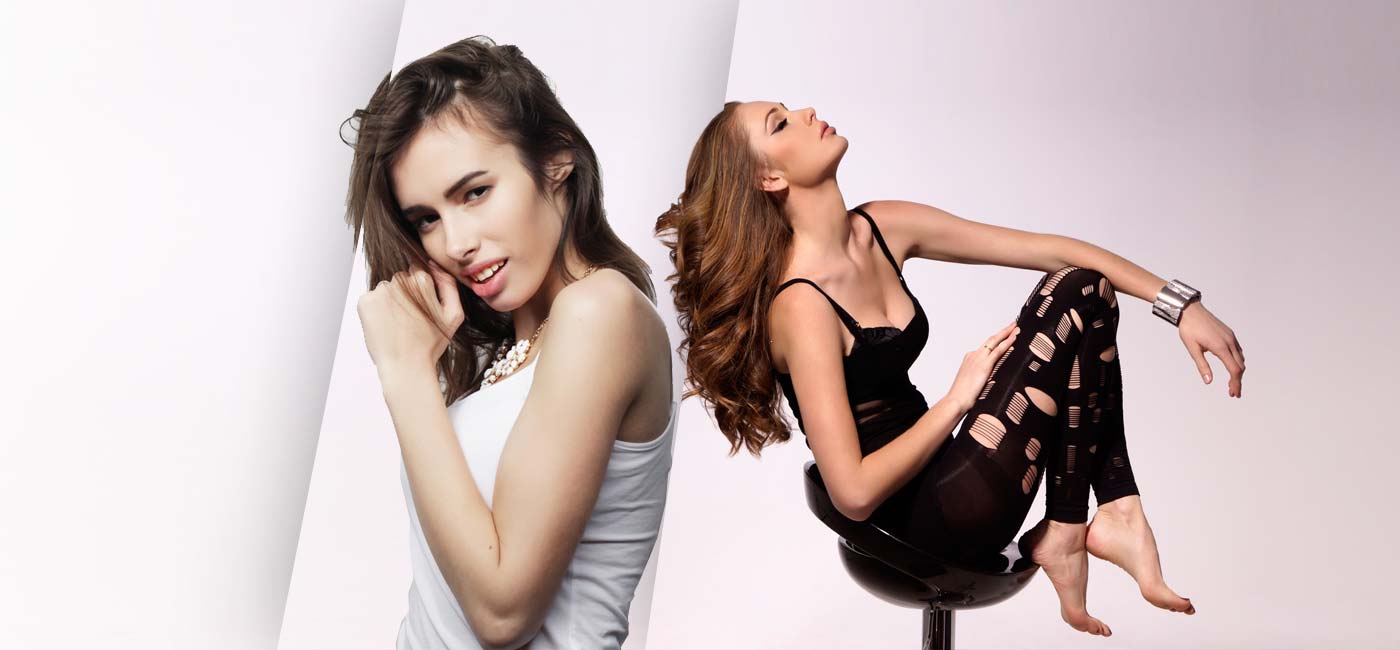
Posing Tips for Models: Body Posture, Facial Expression, Posing!
Anyone who believes good posing is a matter of talent or luck is very much mistaken. Professional models train their posture, facial expressions, and poses as systematically as athletes train their competition routines — and the difference between an average test shoot and a bookable portfolio is almost always down to exactly these three factors. This guide gives you the specific skills agencies expect from applicants — and which most people simply don’t learn anywhere.
Posture: The Foundation That Decides Everything
Before a model even uses a facial expression or tries out a creative pose, the basic posture must be solid. Photographers and
The most common mistake among beginners is the so-called “turtle syndrome”: shoulders lift upwards, the head juts forward. This makes every neck look shorter and every silhouette heavier. Countermeasure: before every shoot, circle your shoulders consciously for 60 seconds, then actively pull them down and hold them there.
- Distribute weight onto one leg
- Tilt hips 15–30° towards the camera
- Shoulders low, sternum slightly lifted
- Chin slightly forward and downward
- Hands relaxed — never tense
Standing Poses: How to execute standing poses correctly
When it comes to standing poses: the line from the ankle to the hip determines the overall effect of the image. A slightly bent knee breaks the hard straight line and immediately makes the silhouette softer and more elegant. Those who additionally turn their toes slightly inward (Pigeon Toed) create the optical illusion of longer legs — a trick that experienced models have used on the
Mastering sitting and lying poses
Sitting poses can be more treacherous than they appear. Anyone sitting on a surface immediately loses body tension and appears broad. The solution: sit only on the front edge, slightly lean forward with the upper body, and bend one leg. In lying poses, the back line is crucial — a raised arm visually elongates the entire body length by several centimetres.
- Never sit flat and relaxed on a surface
- Rest elbows rather than placing hands flat
- Lying poses: always maintain slight body tension
- Never have legs parallel — always shift or bend them
Facial expression: The underestimated tool
Agencies reviewing applications for
“I always tell new models: Your face is your strongest tool — but only if you know how to use it. Whoever tries to look good in front of the camera has already lost. It’s about feeling, not about imitating.”
— Experienced Casting Director, international fashion market
Eyes: The direct link to the viewer
Eyes make up around 70% of the facial expression in model photography. “Smizing” — smiling with the eyes without moving the mouth — is not a fashion trend, but a technique that works on high-gloss pages worldwide. Exercise: Look into the mirror and communicate different emotions with just your eyes — curiosity, confidence, tenderness, strength. Whoever masters this technique stands out immediately in every
Keep the mouth and jaw relaxed
Jaw tension is one of the most common mistakes in the studio. It makes the face look more angular and visually narrows the neck. Solution: Just before the shot, open your mouth slightly and close it again — this relaxes the jaw muscles. Then keep your lips loosely together, slightly open, or consciously adopt a half-smile. Use a full smile deliberately — it doesn’t suit every campaign.
- Actively relax the jaw before every shot
- Place the tongue gently against the upper jaw — sharpens the jawline
- Never let your gaze wander — always fixate on a point
- Do facial exercises daily in front of the mirror
Posing Techniques: From Basic to Editorial
There is a clear difference between commercial poses and editorial poses. Anyone approaching a
The 5 Most Important Posing Rules
- Always define a clear line on the body
- Never press your hands flat against your body
- Create a triangle between the arm and the body
- Think through poses from head to toe, not just the upper body
- Hold each pose for 2–3 seconds, then vary it
The “Triangle Rule” is particularly effective: always create at least one triangle between arms and body, between legs or between head and shoulder. Triangles create visual tension, rectangles appear static and uninteresting. This is not an opinion — this is image composition.
| Posing Type | Application Area | Body Posture | Facial Expression |
|---|---|---|---|
| Commercial | Catalogue, Advertising, Online Shop | Open, approachable, relaxed | Friendly, natural smile |
| Editorial | Magazine, Fashion Features | Conceptual, angular, dynamic | Neutral, intense, storytelling |
| Beauty | Cosmetics, skincare, hair | Minimal, focus on face/detail | Clean, clear, emotion-driven |
| Fitness/Sport | Sportswear, health brands | Strength, energy, movement | Focused, strong, motivated |
| Curvy/Plus Size | Plus sizes, lifestyle | Confident, accentuate curves | Confident, warm, inviting |
Anyone specialising in
Posing Checklist for Your Next Shoot
Use this checklist directly before your next shoot — whether it’s for your first
- ☐ Shoulders consciously pulled down
- ☐ Weight on one leg, hip shifted
- ☐ Jaw relaxed, mouth slightly open
- ☐ Focal point in front of the shot defined
- ☐ Hands loose — no fist clenching
- ☐ Triangle created between arm and body
- ☐ Chin slightly tilted forward
- ☐ Whole body included in the pose
- ☐ Different variations of the same pose planned
- ☐ Facial expression warm-up done (2 minutes)
If you’re already considering whether you meet the requirements to become a model or what model measurements and requirements agencies look for, you know: posing skills are now just as essential as measurements or skin condition. Those who also want to know what happens after the shoot should find out about the specific
For those wondering whether
Those who are now ready to take the next step can apply directly at CM Models now — and put what has been learned here directly into the application photos.
Common Questions About Posing for Models
How long does it take to learn professional posing?
With 15–20 minutes of targeted mirror training each day and at least two test shoots per month, models can see measurable improvements in their visual impact after 6–8 weeks. Full posing competence for commercial and editorial assignments develops over 6–12 months of continuous practice — not overnight, but significantly faster than most assume.
Do I need to attend a modelling school to learn posing?
No. A modelling school is not a requirement and is neither requested nor preferred by most
Which poses are suitable for agency application photos?
For headshots, the rule is: a natural, frontal facial image without exaggerated poses, a half-body shot with a slightly turned hip and open expression, as well as a full-body shot with a clear silhouette. No extreme posing, no clichéd hands-on-hips poses. Agencies want to see potential, not a finished performance. Anyone applying to a
How important is posing compared to measurements and appearance?
More important than most people think. Even someone with the ideal measurements won’t be booked long-term without posing skills. Agencies — whether you contact a model agency or present yourself in person — see applicants with perfect measurements every day who freeze in front of the camera. At the same time, there are successful models who don’t meet all the measurement ideals but are consistently booked thanks to convincing expression and technically strong posing. Posing is the lever you have complete control over.

Recording a casting video: What to keep in mind? 6 tips from our bookers
Men's Model - From the Application to the First Jobs

Model Agency Without a Minimum Size: Measurements and Weight

Model agency from 30 - becoming a model at 30+ years
Model Agency Fitness - Athletic Models for Fashion and Products

Writing to a modelling agency: What your perfect application looks like